

One of the best things about being a direct-to-consumer brand is freedom. You don’t have to build out retail distribution. You don’t have to spend months at trade shows and gift shows, or sit across the table from wholesalers, distributors, and retailers hoping someone picks up your line. You go straight to the consumer. You own the customer, the price, the story, and the channel.
But there is a downside, and it shows up when products don’t sell as well as expected. Sales may fall short of what you needed. Your customer acquisition cost climbed, the ads that used to work stopped working, or ad prices turned a SKU that was profitable in spring into a loss. Maybe a cheaper copycat showed up on Amazon a few months after launch, the TikTok or influencer moment that drove demand faded, or a product refresh made last season’s version obsolete.
Whatever the reason, you’re left with excess inventory and SKUs you need to exit, and the same freedom that made the business work starts working against you. There is no retail partner to push product back to, no buyer who has seen your sell-through, and no quiet outlet that already knows your brand. Every unit you can’t sell at full price is now your problem alone.
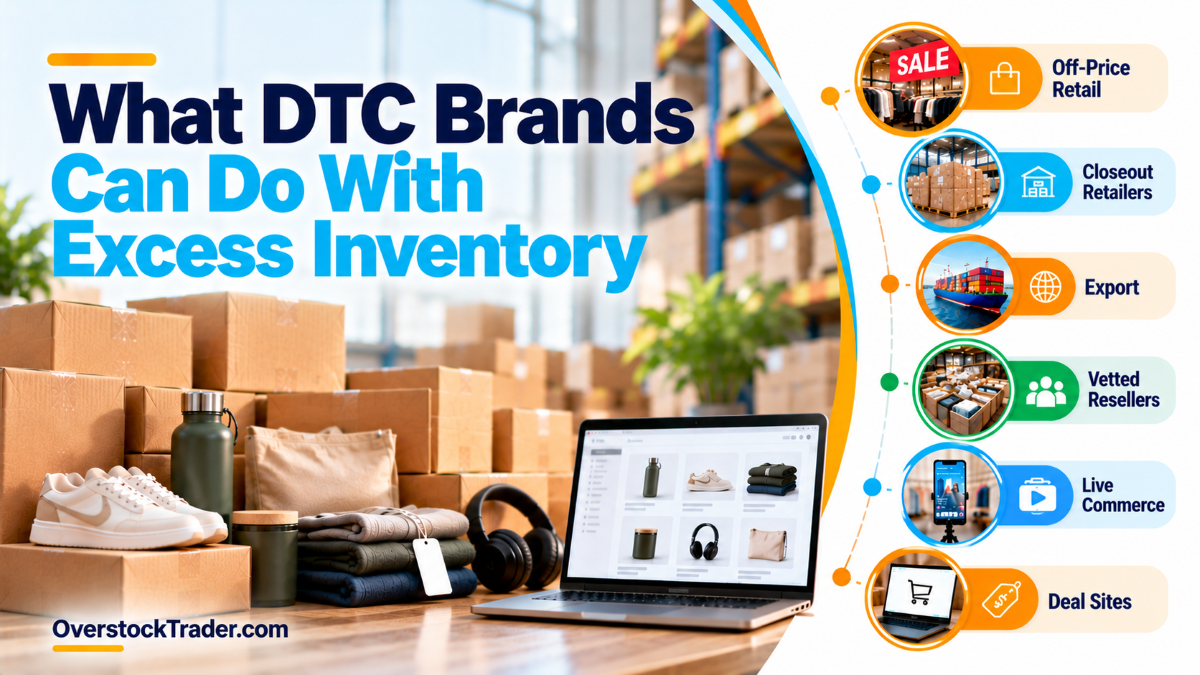
There are several ways to move excess DTC inventory, including off-price retailers, closeout stores, exports, trusted resellers, live commerce, and deal sites. The best option depends on how well-known your brand is, whether your products are ready for retail, and how much control you want over where and how they’re sold.
Why Excess Inventory Hits DTC Brands Harder
Every product business deals with overstock at some point. What makes it harder for DTC brands comes down to a handful of gaps that traditional brands rarely have to think about.
There is no one to share the problem with
A traditional brand selling into retail has a buffer. When a product underperforms, there are markdown allowances, return-to-vendor negotiations, and buyers who have cleared the brand’s goods before. A lot of the excess gets absorbed somewhere in the chain before it ever comes back to the brand.
A DTC brand is the whole chain. You placed the PO, you paid for the freight, and the inventory sits in your 3PL with your name on the storage invoice every month. Nobody downstream is going to take some of it off your hands.
Your pricing is public and your customers are watching
When a wholesale brand discounts, it usually happens on someone else’s shelf, in someone else’s name. When a DTC brand discounts, it happens on the homepage, in the email list, and in front of the exact customers who paid full price last month.
That makes every markdown on your own site a pricing decision for the entire brand, not just for the excess. Run enough of them and you teach your best customers to wait for the next sale.
No retail distribution means low brand recognition
A DTC brand can be doing eight figures online and still be invisible to most shoppers. If someone hasn’t seen your Facebook or Instagram ads, your influencer partnerships, or your other advertising, they have no idea who you are. There’s no shelf at Target or Macy’s that introduced them to the product.
That matters in the secondary market. Off-price buyers want brands their shoppers recognize, because a shopper walking the aisle needs to know a deal when they see one. Strong online numbers don’t change the fact that the customer at the register has never heard of you.
No UPC codes means no comp pricing
Brands that sell only on their own site often never register UPCs.Without a UPC, a buyer can’t scan the item, look it up, or see what it sells for anywhere else. There’s no real way to understand comp pricing.
To a buyer, a product without comps is a product without a proven value. They can’t verify your MSRP, they can’t see how it has sold, and they can’t easily slot it into their own pricing. That uncertainty almost always shows up as a lower offer, or no offer at all.
No retail packaging means your product gets judged by its box
DTC products are built to ship to a customer’s door, not to sit on a shelf. An air purifier ships in a plain brown box. A premium pot or pan ships in a brown box. Clothing comes in poly bags without the hang tags shoppers are used to seeing.
Without retail packaging , your product gets compared to lower-quality products on looks alone. A shopper sees a brown box next to a fully branded competitor and assumes the brown box is the cheaper, lesser item, even when the product inside is better. Buyers know this, and they price it in. Every packaging gap narrows the list of buyers who can take the inventory as is.
The math was built on full price
DTC margins look great on paper, but the real cost of a sale includes the customer acquisition spend behind it. Inventory that was forecast against a certain ad budget and conversion rate doesn’t get cheaper to sell when demand softens. It gets more expensive. Spending more on ads to push units you’re already discounting is how a slow SKU turns into a loss.
That’s why the instinct to “just sell it ourselves” often costs more than it recovers. Every month the inventory sits, carrying costs keep adding up, and we’ve written about how the financial cost of holding excess inventory usually runs higher than brands expect.
Matching DTC Excess Inventory to the Right Channel
The secondary market has more homes for DTC inventory than most founders realize. What matters is matching the inventory to a channel based on brand sensitivity, volume, condition, and how the product is packed. No single channel is right for everything, which is why we evaluate each situation before recommending one.
| Channel | Best fit for | Brand visibility |
| Off-price retail | Recognizable brands, retail-ready packaging, current product | In-store, nationally |
| Closeout retailers | Everyday categories, retail-ready packaging, value-driven product | In-store, regionally or nationally |
| Export | Brand-sensitive inventory, large quantities, any packaging | Outside your home market |
| Vetted resellers | Mixed SKUs, smaller quantities, aged or off-cycle product | Controlled, with channel restrictions |
| Live commerce | Products that demo well on camera, giftable items | Online, during live shows |
| Deal sites | Products with a clear value story, giftable or seasonal items | Online, time-limited |
Off-price retail
Off-price and discount retail are both real options, but only when the product is retail ready and can be merchandised in a store. That means a UPC, packaging that can sit on a shelf or hang on a rack, and a case pack a distribution center can receive. Inventory that ships in a brown box or a poly bag usually isn’t a fit for either channel as is.
If your brand has some recognition and your packaging is store ready, off-price is often the highest-recovery outcome. Getting there takes more than an email to a buyer, though. Off-price buyers see a huge volume of offers, and a DTC brand without retail history needs a clear case. Our article on what brands need to know before selling to off-price retailers covers what they look for.
Closeout retailers
Closeout retailers are less dependent on brand recognition and more focused on value and category, but the product still has to be ready to merchandise in a store. For DTC brands in everyday categories like home, personal care, or pet with retail-ready packaging, this can be a strong fit. The real economics of selling to discount retailers are different from off-price, but for the right inventory the volume makes up for it.
Export
For brands that are especially protective of their domestic pricing, export is one of the most discreet options available. The inventory goes to markets where your customers will never see it, and international buyers are often less concerned with retail-ready packaging. We’ve written about the advantages of exporting surplus inventory if you want to go deeper.
Vetted resellers
Professional resellers have become one of the most useful channels for DTC inventory, especially aged, mixed-SKU, or smaller quantities that larger retailers won’t touch. Who you sell matters here. Working with resellers who agree to channel restrictions, such as no Amazon or no listing below a set price, keeps the product moving without it showing up next to your full-price listings. Here’s more on why brands work with resellers for their excess.
Live commerce
Live selling platforms like Whatnot have opened a newer path for products that sell well when someone demonstrates them on camera. A good host can tell your product story in a way a static listing never will, which helps close the brand recognition gap. For DTC brands, this can recover more than a traditional bulk sale, often on a revenue share basis. We’ve looked at how Whatnot is changing excess inventory strategy for brands.
Deal sites
Daily deal and flash sale sites move a lot of product in a short window to shoppers who are actively looking for a bargain. The sale runs for a limited time, so the discount doesn’t sit in public indefinitely the way a marketplace listing does. Products with strong imagery and a clear value story tend to do best here, and the site needs confidence that orders will ship on time. Packaging isn’t a problem here either. Deal sites ship straight to the shopper, so mailer boxes are often a better fit than retail packaging.
How to Get Your Inventory Ready for Buyers
Once you know where the inventory can go,. The next step is making it easy for a buyer to say yes. DTC brands tend to have great data on their customers and thin data on their inventory, at least in the form secondary market buyers want to see. Closing that gap before you go to market makes a real difference in both speed and recovery.
Build a clean manifest. List every SKU with a description, quantity, unit cost, MSRP, UPC if you have one, condition, and warehouse location. Buyers move fast on inventory they can understand in one read, and they discount heavily for anything they have to guess at.
Be honest about packaging. If units ship in mailer boxes or lack retail barcodes, disclose that upfront. It may narrow the buyer pool, but surprises at pickup can do far more damage to a deal than a clear disclosure from the start.
Show your proof of demand. Off-price and discount buyers can’t see your Shopify dashboard. Sell-through history, review counts, and press can help fill the gap a missing retail track record leaves, especially for a brand they haven’t heard of.
Decide your boundaries early. Know which channels, regions, and price points are off limits before you start conversations. Clear restrictions protect the brand and also make it easier to find the right buyer quickly, because you’re not entertaining offers you’d never accept.
Sell it as one offer. Selling your best SKUs first and leaving the slow ones behind usually lowers total recovery. Buyers pay more for a full, defined offering, and take-all deals are often the cleanest way to clear everything at once. If you’re unsure what the inventory is worth, our excess inventory evaluation process explains how we look at it.
Frequently Asked Questions
These are some of the questions we hear most often from DTC brands working through excess inventory and returns.
How much will I recover on my DTC excess inventory?
It varies more than most brands expect, typically 5% to 20% of your full retail price.. Where you land depends on brand recognition, category, condition, whether the packaging is retail ready, how much quantity there is, and how current the product is. Retail-ready, in-season product from a recognizable brand land at the higher end. Aged product, DTC-only packaging, or a scattered mix of SKUs lands lower. A clean manifest and acting early are the two things most within your control, and both move offers up.
How do I keep my excess inventory from competing with my own site?
You should define restrictions before you sell your excess stock. Decide which channels, regions, and price points are off limits, and put them in writing with the buyer. For most DTC brands, the safest outcomes are keeping the product offline entirely, through brick-and-mortar retail or export, so it never shows up in a search next to your full-price listings.
What’s the difference between a DTC brand and an ecommerce brand?
An ecommerce brand sells online through channels such as Amazon, Walmart.com, other marketplaces, and wholesale accounts, as well as its own website. A DTC brand sells directly to consumers, usually through its own website, without retailers or marketplaces in between. Most DTC brands are ecommerce brands, but not every ecommerce brand is DTC. The difference matters when inventory stops moving. A multichannel ecommerce brand often has retail or marketplace relationships to lean on, while a DTC brand owns the whole problem, from public pricing to finding buyers who have never seen the product on a shelf. For multichannel sellers, our guide on how ecommerce sellers can turn excess inventory into profit covers their options.
What should I do with slow-moving inventory sitting in my 3PL?
You should act sooner rather than later. Every month it sits in a 3PL, the storage fees add up and the product gets older, which shrinks the pool of interested buyers. Start with a clean manifest of what you have, including quantities, unit costs, MSRPs, and condition, so you can get a realistic read on what the inventory is worth and where it fits.
What should DTC brands do with customer returns?
Most DTC brands treat returns as a write-off. They assume opened, used, or repackaged goods have no real value, so they eat the loss, donate them, or pay to have them destroyed. That’s usually money left on the table. We buy returns directly or place them with buyers who grade, repackage, and resell them in channels that stay away from your full-price customers. The best results come from grading returns (like new, open box, used, damaged), keeping them separate from new overstock, and moving them out on a regular schedule rather than letting them pile up. Our reverse logistics page covers how we handle returns.
Why won’t off-price retailers buy my DTC brand’s inventory?
Usually, it comes down to brand recognition, missing UPC codes, or packaging that isn’t retail ready. Off-price buyers need products their shoppers recognize and that can be merchandised in a store. Inventory that doesn’t meet that bar often does well through export or vetted resellers instead.
How do I get my DTC brand into off-price retail?
Start by making the product retail ready. Off-price buyers need UPC codes, packaging that can sit on a shelf or hang on a rack and case packs their distribution centers can receive. If your product ships in a brown box or a poly bag, that’s the first gap to close. Next, build the case for your brand. Off-price buyers can’t see your Shopify dashboard, so bring sell-through history, review counts, press, and a verifiable MSRP that shows shoppers they’re getting a real deal. Current, in-season products with meaningful quantities get much more attention than a few cases of last year’s colors.
Finally, think about how you get in front of buyers. Off-price buyers see a huge volume of offers, and a DTC brand with no retail history is easy to pass over in a cold email. Working with a buyer that already has off-price relationships usually gets inventory reviewed faster and on clearer terms. You can learn more about how off-price retail distribution works.
Moving DTC Inventory Without Giving Up Control
Almost every product business ends up with excess inventory at some point, and nearly every DTC brand we work with has been through it. A good outcome comes down to picking a channel that fits, moving before the product ages, and putting the restrictions in writing.
Because DTC brands sell online, price protection comes first. The last thing you want is your own excess showing up on Amazon or Google Shopping at a lower price, right next to your full-price listings. That’s why, for DTC brands, our default is keeping products offline. Live selling and deal sites are the exception, because the sale runs for a short window and then it’s gone. When the product is retail ready, brick-and-mortar off-price and discount retailers are often the answer. When it isn’t, export markets can take it as is, and your inventory reaches new customers without ever showing up next to your own site in a search result.
The DTC brands that come through an overstock situation in the best shape tend to do a few things well. They act before the inventory ages. They match each part of it to the channel that actually fits, whether that’s off-price, discount retail, export, or a vetted reseller. And they set clear limits on where the product can and can’t be sold. That’s the same control that made the DTC model work, applied to the inventory that didn’t sell.
